
Best Nasal Moisturizer for CPAP Users
Table of Contents
- Why CPAP Users Need Specialized Nasal Moisturizers
- Best Nasal Gel for CPAP Users: Rhinase Options Compared
- Saline Spray for CPAP Dryness: Gel vs. Spray Solutions
- CPAP Nose Sores Treatment: Prevention and Relief
- Managing Dry Nose from CPAP: Ingredients and Application Tips
- What Makes a Nasal Moisturizer Safe for CPAP Equipment
- Comparison Table: Rhinase Nasal Moisturizers at a Glance
- Frequently Asked Questions
Last Updated: October 12, 2026
Why CPAP Users Need Specialized Nasal Moisturizers
CPAP therapy saves lives, but continuous airflow dries out your nasal passages. The best nasal moisturizer for CPAP users addresses not just general dryness, but the irritation, rawness, and sometimes bleeding that comes from eight hours of pressurized air every night.
Your nose isn't designed for constant airflow. CPAP machines push air through your nasal passages continuously, bypassing your body's natural humidification. The result ranges from uncomfortable to genuinely painful: crusted passages, nosebleeds, and mask-related chafing that worsens when nasal tissue is already irritated.
The right nasal moisturizer solves this without compromising your therapy.
A nasal moisturizer designed for CPAP use must do three things: hydrate the nasal cavity itself (not just external skin), last through the night, and stay compatible with your mask seal and equipment. Standard facial moisturizers fail on all three counts. Water-based CPAP gels penetrate deeper into nasal tissue, hold moisture longer via wetting agents, and won't degrade mask materials.

Best Nasal Gel for CPAP Users: Rhinase Options Compared
Rhinase offers three distinct nasal gel formulations, each addressing different aspects of CPAP-related nasal dryness. We've broken down each option so you can match your specific situation to the right product.

Rhinase Allergy Relief Lubricating Nasal Gel (1 oz)
This is the entry point for CPAP users who want effective relief in a portable size, ideal for travel or a nightstand backup.
The formula contains dual wetting agents and dual salts (sodium and potassium), moisturizing efficiently without the stinging of imbalanced saline solutions. At pH 6.2, it matches your nose's natural environment, important because mismatched pH can trigger irritation or nosebleeds, especially with CPAP pressure.
What makes this version work for CPAP: it's steroid-free, so no rebound dryness from long-term steroid spray use, and it's safe alongside steroid medications for allergies. The gel consistency stays where you apply it longer than a spray.
The trade-off is size: one ounce runs out faster, so nightly users repurchase more often.
Rhinase Dry Nose Relief Lubricating Nasal Gel (60 g)
The 60 g size is the sweet spot for most nightly CPAP users: the same formula as the 1 oz bottle in a larger container that lasts longer and costs less per ounce.
This size means you're not constantly reordering, and it fits comfortably in a bathroom drawer. The dual wetting agents and dual salts remain the same, delivering the same pH-balanced, steroid-free relief.
For CPAP users, the longer-lasting moisture means you're less likely to wake mid-therapy with that raw, burning sensation.
At $23.85, that's more economical than the 1 oz option for nightly use, with fewer reorders.
The only downside: if you're new to nasal gels, committing to 60 g is a bigger investment than starting with 1 oz.
Rhinase X Soothing Nasal Gel with Natural Xylitol
This is the premium option for CPAP users who want the most advanced formulation: Rhinase X adds natural xylitol to the dual wetting agents and dual salts for longer-lasting hydration.
Xylitol is a natural humectant, actively drawing moisture into nasal tissue and holding it there. For CPAP users, this extends relief beyond the initial application, keeping nasal passages hydrated deeper into the night than standard saline gels.
The hypotonic formula (sodium and potassium without isotonic salt concentrations) works efficiently even with disrupted CPAP airflow. It's steroid-free, safe for children, and compatible with other medications.
At $18.12 for 1 oz, it's competitively priced with the standard Allergy Relief formula, but the xylitol addition benefits users with severe CPAP-related dryness. If nosebleeds or significant rawness is your main issue, it's worth the investment.
Saline Spray for CPAP Dryness: Gel vs. Spray Solutions
The choice between a gel and a spray comes down to how you want to deliver moisture and where you want it to stay.
Sprays deliver moisture quickly and feel refreshing, but don't stay in your nasal passages as long as gels.
Gels, by contrast, adhere to nasal tissue and stay put through continuous CPAP airflow, which is why CPAP-specific guidance recommends gel over spray for overnight use.
The Rhinase Nasal Care Combo Pack pairs a gel for nightly CPAP use with a spray for daytime relief or external skin irritation, addressing both internal nasal dryness and external mask-related chafing.

For internal nasal dryness from CPAP, use the gel; for daytime dryness or mask-related skin irritation, the spray works well. They're complementary tools, not competing options.
CPAP Nose Sores Treatment: Prevention and Relief
Nose sores from CPAP happen for two reasons: mask pressure creates micro-abrasions, and nasal dryness prevents tissue from healing. Treating them means addressing both.
Prevention is easier than treatment. A consistent nasal moisturizer before bed creates a protective barrier against mask pressure, and the dual wetting agents in Rhinase formulations maintain moisture in nasal tissue, making it more resilient to friction.
If sores have developed, the same moisturizers help them heal faster by keeping tissue hydrated. A steroid-free gel matters here because steroids can thin nasal tissue over time, making future sores more likely.
Common mistake: using petroleum-based ointments around your CPAP mask. Petroleum degrades silicone mask cushions and interferes with the seal. Water-based gels like Rhinase are compatible with all standard CPAP equipment materials.
If sores persist despite consistent moisturizer use, your mask fit may be the issue. Sores typically develop at the nose bridge (full-face masks) or inside nostrils (nasal masks or pillows). Adjusting fit often resolves it; keep using the moisturizer while troubleshooting.
Managing Dry Nose from CPAP: Ingredients and Application Tips
The ingredients in your nasal moisturizer determine how well it works and how long relief lasts.
Wetting agents are the active ingredient: humectants that draw moisture into nasal tissue and hold it there.
Salts matter too. Nasal tissue is naturally saline, so salt concentration affects absorption.
pH balance is critical for CPAP users. A pH of 6.2, matching healthy nasal tissue, means no stinging, irritation, or triggered nosebleeds.
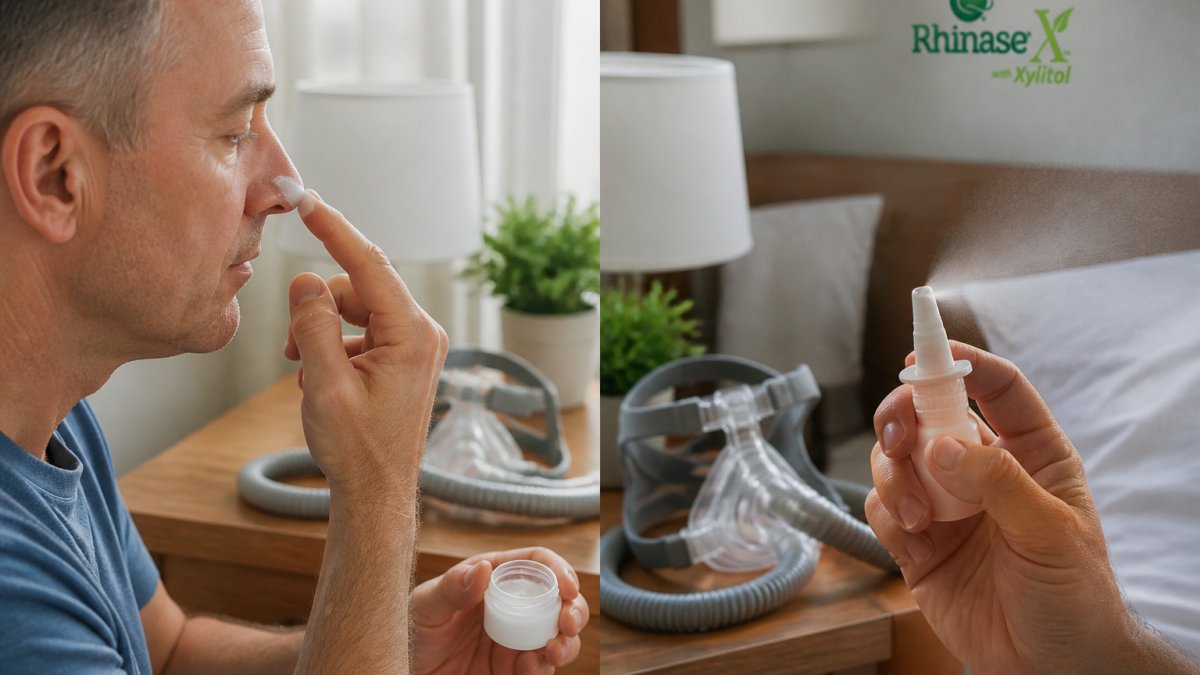
Application timing and technique matter as much as the product. Apply nasal gel 15-20 minutes before your CPAP mask so it settles into your nasal passages before airflow begins.
Use a small amount: a pea-sized dab per nostril is enough. More product just means more waste as CPAP airflow pushes the excess out.
Apply inside your nose, not just on external skin. The problem is internal dryness from continuous airflow, so the gel must reach the nasal cavity.
Fragrance-free, dye-free formulations (like all Rhinase gels) reduce allergic reaction risk. Nasal tissue is already stressed from CPAP use; fragrance or dyes only add irritation.
What Makes a Nasal Moisturizer Safe for CPAP Equipment
Not all nasal products are CPAP-safe. Some damage mask materials, interfere with seal integrity, or cause equipment malfunction.
Water-based gels are CPAP-safe. Oil- or petroleum-based products degrade silicone mask cushions and plastic components.
Steroid-free formulations matter for your equipment too. Some steroid sprays accumulate residue that clogs CPAP tubing or damages internal components over time. Water-based, steroid-free gels don't leave this buildup.
Check the ingredient list: if you see petroleum, mineral oil, or lanolin, skip it for CPAP use. Look for water-based gels with wetting agents and saline as primary ingredients.
Fragrance and dyes don't directly damage equipment but can trigger nasal inflammation that makes CPAP therapy less comfortable.
pH matters for equipment compatibility too. A pH-balanced product (6.2) won't cause the nasal tissue irritation that leads to bleeding or swelling, which can affect mask fit and create leaks that force your machine to work harder.
| Ingredient | CPAP-Safe? | Why or Why Not |
|---|---|---|
| Water-based gel | Yes | Won't degrade mask materials or clog equipment |
| Petroleum jelly | No | Degrades silicone and plastic mask components |
| Mineral oil | No | Accumulates in tubing and damages seals |
| Wetting agents | Yes | Improve moisture retention without equipment damage |
| Dual salts | Yes | Match nasal tissue chemistry; no equipment interaction |
| Steroids | Caution | Can leave residue that clogs CPAP tubing |
| Fragrance | No | Triggers inflammation |
| pH 6.2 | Yes | Matches nasal tissue; prevents damage from irritation |
Comparison Table: Rhinase Nasal Moisturizers at a Glance
| Product | Size | Price | Best For | Key Differentiator |
|---|---|---|---|---|
| Rhinase Allergy Relief (1 oz) | 1 oz | $18.32 | Travel, testing, backup supply | Portable, entry-level CPAP relief |
| Rhinase Dry Nose Relief (60 g) | 60 g | $23.85 | Nightly CPAP users | Three-month supply, best value per ounce |
| Rhinase X with Xylitol (1 oz) | 1 oz | $18.12 | Severe dryness, nosebleeds | Natural xylitol for extended relief |
| Rhinase Combo Pack | Gel (1 oz) + Spray (1 oz) | $26.95 | Day and night relief | Addresses internal and external irritation |
CPAP-related nasal dryness is treatable, but it requires a product designed for the specific challenge of continuous airflow through nasal tissue. The best nasal moisturizer for CPAP users combines water-based formulation, dual wetting agents, pH balance, and steroid-free relief, everything Rhinase gels deliver.
Start with the size that matches your commitment level. New to nasal gels? The 1 oz Rhinase Allergy Relief or Rhinase X lets you test the approach without a large upfront investment. Committed nightly CPAP user? The 60 g Dry Nose Relief offers better value and a three-month supply. Dealing with both internal dryness and external mask irritation? The Combo Pack covers both.
Apply consistently 15-20 minutes before bed, use a small amount, and apply inside your nostrils where CPAP airflow creates the most dryness.
The goal isn't just comfort, it's sustainable CPAP therapy. When nasal dryness stops waking you up or forcing mask adjustments, you actually use your machine as prescribed, which means better sleep and better health outcomes. That's what the best nasal moisturizer for CPAP users makes possible.
Frequently Asked Questions
Can I use a nasal moisturizer with my CPAP mask on?
Yes, but timing matters. Apply nasal gel or spray to the inside of your nose before putting on your CPAP mask, allowing it to set for a minute or two. Water-based gels like Rhinase work best because they won't damage mask materials or interfere with the seal. Avoid petroleum-based ointments, which can degrade silicone cushions and liners. The combo pack option gives you both gel for nighttime prep and spray for daytime relief.
What ingredients should I avoid in a nasal moisturizer used with CPAP?
Avoid petroleum-based products and heavy oils that can break down silicone or rubber mask components. Skip products with aloe vera or fragrances, which may irritate already-sensitive nasal passages. Choose water-based formulations like Rhinase gels, which are compatible with CPAP equipment and won't leave residue on mask cushions or heated hoses. Always check product labels for 'CPAP-safe' or 'water-based' designations.
How long does nasal gel relief last for CPAP dryness?
Most nasal gels provide moisture relief for several hours. Rhinase products, formulated with dual wetting agents and dual salts, are designed to maintain hydration throughout the night for CPAP users. For daytime dryness, the saline spray offers quick relief. Reapply as needed, but avoid overuse. If dryness persists despite regular application, consider adjusting your CPAP humidity settings or consulting your sleep specialist about equipment modifications.
Is Rhinase X with xylitol better for CPAP-related nasal dryness than regular saline?
Rhinase X includes xylitol, a natural humectant that draws moisture into nasal tissues and provides longer-lasting hydration than standard saline alone. The hypotonic formula with dual salts and wetting agents makes it particularly effective for CPAP users experiencing stubborn dryness. However, the standard Rhinase formulations also contain dual wetting agents, so choice depends on whether you want the added xylitol benefit or prefer a simpler saline base.
Can I use a nasal moisturizer if I'm also using steroid nasal sprays?
Yes. Rhinase products are pH-balanced at 6.2 and formulated to work safely alongside steroid medications without interfering with their effectiveness. In fact, many CPAP users benefit from combining treatments: steroids for inflammation or congestion, and nasal moisturizers for dryness relief. Always consult your doctor before combining treatments, and apply them at different times if recommended by your healthcare provider.