

How to Use Saline Spray With CPAP: Step by Step
Table of Contents
- What You'll Need Before You Start
- How to Use Saline Spray With CPAP Step by Step
- Is a CPAP Nasal Care Routine Necessary?
- Saline Spray vs Nasal Gel for CPAP
- How to Prevent Nosebleeds From CPAP
- Timing, Frequency, and Heated Humidification
- Common Mistakes and Adverse Reactions to Watch For
- Frequently Asked Questions
Last Updated: September 21, 2026
What You'll Need Before You Start
Nasal dryness is one of the most common reasons people struggle with CPAP therapy. The constant airflow dries out the mucous membranes lining your nasal passages, causing irritation, congestion, and sometimes nosebleeds that make wearing the mask feel impossible.
- A saline nasal spray bottle
- A tissue or soft cloth
- Mild soap and warm water
- Your CPAP mask and machine
- A mirror (optional, but helpful at first)
How to Use Saline Spray With CPAP Step by Step
Learning how to use saline spray with CPAP step by step takes about two minutes once you build the habit. The order matters: you want your nasal passages clear and moist before the mask goes on, not after.
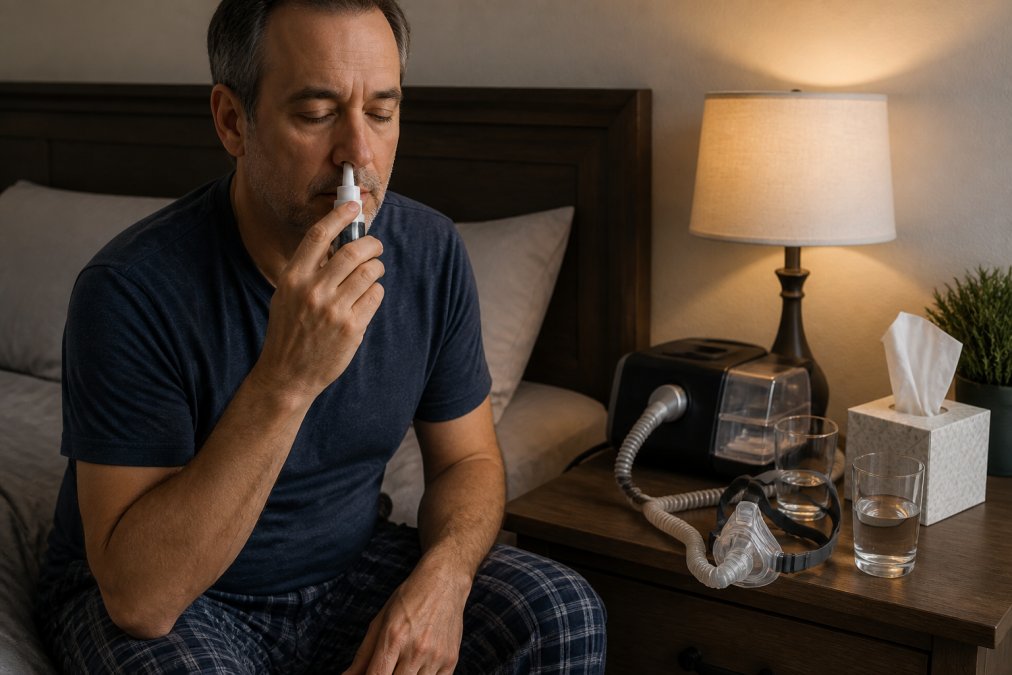
Step 1: Wash Your Hands and Clear Your Nose
Start with clean hands, you're about to touch your nose, and you don't want to introduce germs into irritated tissue. Wash with soap and warm water for at least 20 seconds, then gently blow your nose into a tissue. Don't blow hard; forceful blowing can push mucus into your sinuses. One soft blow per nostril is enough.
Step 2: Prime the Bottle and Aim the Nozzle
If the bottle is new or hasn't been used in a few days, prime it first. Point it away from your face and press once or twice until a fine mist comes out.
Step 3: Spray, Breathe Gently, and Repeat on the Other Side
Press the pump once while breathing in softly through your nose. Don't sniff hard, a gentle breath pulls the saline across your nasal passages without pushing it into your ears. Repeat on the other side. If liquid runs down your throat, that's normal; it just means you used a little too much or sniffed too forcefully.
Step 4: Wait, Then Fit Your Mask
Wait about 30 to 60 seconds to let the saline do its job, blow your nose once more if needed, then put on your CPAP mask and start therapy. This pause matters: strap the mask on immediately and the airflow can push the saline back out before it moisturizes your nasal passages.
| Step | What You Do | Time Needed |
|---|---|---|
| 1 | Wash hands, blow nose gently | 30 seconds |
| 2 | Prime bottle, aim nozzle back | 15 seconds |
| 3 | Spray each nostril, breathe softly | 20 seconds |
| 4 | Wait, then fit your mask | 60 seconds |
Is a CPAP Nasal Care Routine Necessary?
Yes, for most CPAP users a nasal care routine is necessary. CPAP pushes filtered air through your nose all night, stripping moisture from your mucous membranes, so without a routine, dryness builds up night after night.

Common signs you need one:
- A dry, burning feeling inside your nose each morning
- Crusty buildup around the nostrils
- Congestion that gets worse, not better, with CPAP use
- Frequent nosebleeds
- A mask seal that keeps breaking because you're mouth-breathing
Saline Spray vs Nasal Gel for CPAP
Saline spray and nasal gel do different jobs, and most CPAP users benefit from both. Saline spray is thin and watery, loosening dried mucus and flushing out irritants. Nasal gel is thicker and stays in place, coating the nasal passages with lasting moisture.

Here's how they compare:
| Feature | Saline Spray | Nasal Gel |
|---|---|---|
| Texture | Thin, watery mist | Thick, lubricating |
| Main job | Loosen and flush | Coat and protect |
| Best timing | Before bed, after waking | Right before mask fit |
| Lasting moisture | Short | Long |
| Best for | Congestion, crusting | Severe dryness, nosebleeds |
How to Prevent Nosebleeds From CPAP
Nosebleeds from CPAP happen when dry air cracks the delicate lining inside your nose. The fix is moisture, applied on two fronts: inside your nose and in the air you breathe.
Try these steps:
- Use saline spray every night before bed
- Apply a nasal gel to protect the nasal lining overnight
- Turn up your CPAP humidifier setting
- Keep your bedroom humidity above 30 percent
- Trim your fingernails so you don't scratch when you itch
- Stop any nasal decongestant sprays after three days of use
Timing, Frequency, and Heated Humidification
Most guides tell you to "use saline as needed." That's not a protocol. Here's a specific schedule, plus how to adjust it when your machine already adds heat and moisture.
A Default Saline Schedule for CPAP Users
| Time | Action | Why |
|---|---|---|
| 15 minutes before mask fit | One spray per nostril, gentle sniff | Gives the saline time to loosen crusts and moisturize tissue before airflow starts |
| On waking | One spray per nostril | Clears overnight crusting and rehydrates tissue dried by 6-8 hours of airflow |
| Mid-afternoon (optional) | One spray per nostril | Only if you feel dryness, burning, or crusting between therapy sessions |
The 15-minute pre-mask window is the part most people skip. Spraying and immediately strapping on the mask pushes the saline back out before it can absorb. Fifteen minutes is long enough for absorption and short enough that you won't forget.
How Often Is Too Often?
Saline is not habit-forming and has no rebound effect, so there's no hard ceiling like with decongestant sprays. A common pattern is two to three uses per day. If you're reaching for the bottle five or six times a day, your nose is still too dry, the fix is usually more humidity, not more spray.
Adjusting for Heated Humidification and Heated Tubing
A heated humidifier adds warm moisture to the air your CPAP delivers, changing how much saline you actually need.
- No humidifier: Start with the full two-to-three spray schedule above. Dryness will be highest here.
- Humidifier on low or mid: Keep the pre-mask spray and the morning spray. Drop the optional afternoon dose first if your nose feels fine.
- Humidifier on high, or heated tubing in use: Many users find they only need the pre-mask spray. If your nose feels wet or you're waking up with a runny nose, cut the saline before you cut the humidity.
Rainout and the Saline Connection
Higher humidity settings can cause condensation in the tube, known as rainout, water spraying into your mask, which is uncomfortable and can wake you up. A tube cover or heated hose reduces it. If you're fighting rainout, don't lower humidity below the point where your nose dries out; add a heated hose instead and keep the moisture.
What If You Use a Full-Face Mask?
With a full-face mask, saline can pool in the cushion or drip toward your mouth if you spray too close to mask-fit time. Stick to the 15-minute window and blow your nose gently before fitting the mask. Nasal pillows and nasal masks are more forgiving, but the 15-minute rule still helps.
Common Mistakes and Adverse Reactions to Watch For
Most articles stop at "stop using it and call your doctor." That's not useful at 11 p.m. when your nose is stinging. Here's what to actually do for each reaction.
The Mistakes That Cause Most Problems
- Spraying too hard and sniffing too aggressively. This pushes saline into the eustachian tubes and can cause ear pressure or a brief earache. Spray gently and breathe in softly, you should barely hear the sniff.
- Using tap water in a rinse bottle or neti pot. Tap water is not sterile. The FDA and CDC advise using distilled, sterile, or previously boiled and cooled water for nasal rinsing. Premade saline spray bottles are already sterile, so they're the safer default for daily CPAP use.
- Sharing a spray bottle. Even with a fresh nozzle, cross-contamination is possible. One bottle per person.
- Using an expired or cloudy bottle. Saline has a shelf life. If the liquid looks cloudy or the bottle has been open past its discard date, replace it.
- Skipping the wait time before mask fit. Covered above, but it's the single most common reason people say saline "doesn't work."
- Relying on decongestant sprays for daily relief. Oxymetazoline and similar sprays cause rebound congestion after about three days of continuous use. That makes CPAP harder, not easier.
Troubleshooting Adverse Reactions
Stinging or burning on contact. A brief tingle is normal, especially with a fresh or cold bottle. Stinging lasting more than a minute usually means one of three things: an additive you're reacting to (aloe, fragrance, preservatives), a too-cold solution, or an already cracked nasal lining. Warm the bottle in your hand for a minute, switch to a preservative-free or additive-free product, and if stinging continues, pause and check with a clinician.
When to Stop and Call a Clinician
Stop saline and contact a clinician if you have: bleeding that won't stop, severe nose or sinus pain, fever with nasal symptoms, a reaction spreading beyond the nostrils, or symptoms that worsen over several days. For everyday dryness and crusting, saline and a lubricating gel are the right tools, keep the routine simple enough that you actually stick with it.
Frequently Asked Questions
Can I use saline spray before putting on my CPAP mask?
Yes. Spraying two to three minutes before you fit your mask gives the saline time to absorb into the mucous membranes, so it will not pool in the nasal cavity or drip into your mask. Blow your nose gently first, spray each nostril, wait, then put the mask on. If you use a nasal gel instead, apply it after the spray and give it a minute to settle.
How often should I use saline spray with my CPAP machine?
Most CPAP users do well with one spray in each nostril before bed, plus a second dose in the morning if dryness or crusting persists. If your bedroom humidity drops below 30% in winter, you may need a mid-day spray as well. If you still wake up dry after two weeks of consistent use, raise your heated humidifier setting by one level before adding more sprays.
Should I use a saline spray or a nasal gel for CPAP comfort?
They solve different parts of the problem. Saline spray reaches the upper nasal passages, flushes out allergens and crusts, and is best for daytime congestion and post-nasal drip. A lubricating nasal gel coats the lower nasal passages and the skin around the nostrils, which is where mask friction causes most irritation. Many CPAP users run both: spray first, gel second, then mask.
Is it safe to use saline spray every night with CPAP?
Preservative-free saline is safe for nightly use because it contains no steroids or decongestants that can cause rebound congestion. Stick to isotonic or slightly hypertonic saline rather than medicated sprays, and never share a bottle. If you develop burning, bleeding that will not stop, or pain around the sinuses, stop and talk to your doctor.
Dry nose shouldn't be the reason you give up on CPAP therapy. The routine is simple: spray, wait, fit your mask, and repeat every night. Profounda Health & Beauty makes steroid-free, drug-free nasal care products designed for exactly this problem, including a dual-salt gel that's pH balanced and safe for daily use. Get started with Profounda Health & Beauty and wake up with a nose that doesn't hurt.