

Non-Irritating Skincare for Kids With Sensitive Skin
Table of Contents
- Understanding Sensitive Skin in Children
- Best Fragrance-Free Moisturizer for Kids: What to Look For
- Gentle Face Wash for Kids With Sensitive Skin: Cleansing Without Stripping
- Kids Skincare Ingredients to Avoid: What Parents Need to Know
- Sun Protection for Young Skin: Mineral Sunscreen Essentials
- Patch Testing Skincare Products for Children: Step-by-Step Method
- Building a Gentle Skincare Routine for Sensitive Young Skin
- Common Mistakes Parents Make With Children's Sensitive Skin
- Frequently Asked Questions
Last Updated: October 13, 2026
Understanding Sensitive Skin in Children
Non-irritating skincare kids sensitive skin requires a fundamentally different approach than adult skincare. Young skin has a thinner outer layer and a less developed barrier function, making it more vulnerable to irritation from environmental factors, fragrances, and harsh ingredients. At Profounda Health & Beauty, we understand that what works for general skincare often fails for sensitive young skin, and the consequences of getting it wrong range from temporary discomfort to persistent inflammation.
The challenge parents face is distinguishing between normal dryness and genuine sensitivity. A child's skin might react poorly to a product because of fragrance, because the pH is too alkaline, or because an ingredient disrupts their skin barrier. The goal isn't just to avoid problems, it's to actively support skin health with non-irritating skincare that strengthens rather than stresses the barrier.
Best Fragrance-Free Moisturizer for Kids: What to Look For
Why Fragrance-Free Matters
Fragrance is the leading cause of contact dermatitis in children's skincare. Even "natural" fragrances can trigger redness, itching, and peeling in sensitive young skin. A fragrance-free moisturizer removes this irritant entirely, allowing other beneficial ingredients to work without interference.
Many parents confuse fragrance-free with unscented. These terms are legally distinct. Fragrance-free means no fragrance chemicals were added. Unscented means fragrance was added but then masked with other chemicals, a meaningless distinction for sensitive skin. Always choose explicitly fragrance-free products.
Key Ingredients in Effective Moisturizers
The best moisturizers for sensitive young skin contain ingredients that repair and protect the skin barrier. Ceramides are essential, they're lipids naturally present in healthy skin that help seal moisture in and irritants out.
Plant oils like sunflower oil and avocado oil provide additional barrier support without the heaviness of mineral oil. Hyaluronic acid holds water in the skin, though it works best when applied to damp skin.
Avoid moisturizers with parabens, phthalates, sulfates, or alcohol. These preservatives and solvents frequently trigger reactions in sensitive skin. Look for products labeled paraben-free, phthalate-free, and sulfate-free, these omissions matter for young skin.
Our Unscented Hand Cream demonstrates these principles in action. The dermatologist-recommended formula combines fragrance-free hydration with ceramides and natural moisturizing ingredients, absorbing quickly without leaving residue.

Gentle Face Wash for Kids With Sensitive Skin: Cleansing Without Stripping
A gentle face wash for kids with sensitive skin must remove dirt and oil without disrupting the skin barrier. Most children's cleansers are too harsh, they strip away natural oils, leaving skin tight and vulnerable to irritation. The ideal formula cleanses effectively while preserving the protective lipid layer.
pH-Balanced Formulas Protect the Skin Barrier
The skin's natural pH is slightly acidic (around 4.5 to 5.5). Alkaline cleansers disrupt this balance, weakening the barrier and triggering irritation. A pH-balanced cleanser maintains this acidic environment, supporting the skin's natural defense system.
Look for cleansers labeled pH-balanced or pH-neutral. Avoid traditional bar soaps, which are typically alkaline and strip young skin. Cream cleansers and gentle gel washes formulated for sensitive skin are better options. The cleanser should feel gentle on contact, no tight feeling after rinsing, no residual dryness.
Many effective gentle face washes for kids with sensitive skin use non-ionic surfactants, which are milder than conventional detergents. These break down oil and dirt without harsh scrubbing action. Pair a gentle cleanser with lukewarm water and soft patting motions, rubbing or hot water compounds irritation.
Kids Skincare Ingredients to Avoid: What Parents Need to Know
Certain ingredients are known irritants for sensitive young skin. Understanding what to avoid is as important as knowing what to include.
Fragrance and essential oils top the list. Both synthetic fragrance and "natural" essential oils can trigger contact dermatitis. Some parents assume essential oils are safer, they're not.
Retinol and retinoids (including adapalene) are too strong for children's skin.
Salicylic acid and benzoyl peroxide are acne fighters, not general skincare ingredients. They're drying and irritating for sensitive skin in children, even at low concentrations.
Alcohol and fragrance alcohols (like SD alcohol or isopropyl alcohol) are drying and irritating. Avoid any product listing alcohol in the first five ingredients.
Parabens and phthalates are preservatives linked to irritation in sensitive skin. Paraben-free and phthalate-free formulations are now standard for quality children's skincare.
Fragrance-Free Versus Unscented: Label Distinctions That Matter
This distinction is critical and often misunderstood. Fragrance-free means no fragrance chemicals were added to the product. Unscented means fragrance was added but then masked with additional chemicals to hide the smell. For a child with sensitive skin, unscented is not a safe alternative.
Read the ingredient list carefully. If you see "fragrance," "parfum," or "essential oils," the product is not fragrance-free, it's scented. Products labeled fragrance-free should not list any of these terms.
Some brands use "hypoallergenic" to suggest safety, but this term is unregulated and meaningless. A product can be labeled hypoallergenic while still containing common irritants. Always check the actual ingredient list rather than relying on marketing language.
Sun Protection for Young Skin: Mineral Sunscreen Essentials
Sun protection is non-negotiable for children, but many conventional sunscreens irritate sensitive skin. Mineral sunscreen, also called physical sunscreen, is the safer choice for young, sensitive skin.
Mineral sunscreens use zinc oxide or titanium dioxide as active ingredients. These sit on the skin's surface and reflect UV rays, rather than absorbing into the skin like chemical sunscreens.
Chemical sunscreens (oxybenzone, avobenzone, octinoxate) absorb into the skin and convert UV rays into heat. This process can irritate sensitive skin and is associated with hormone-disrupting effects in some studies.
Apply mineral sunscreen generously, most people use too little. A child's face and neck need at least one-quarter teaspoon. Reapply every two hours, or immediately after swimming or sweating.
Look for mineral sunscreens labeled broad-spectrum (protecting against UVA and UVB rays) with SPF 30 or higher. Avoid sunscreens with fragrance, oxybenzone, or retinyl palmitate.
Patch Testing Skincare Products for Children: Step-by-Step Method
Before introducing any new product into a child's routine, patch testing identifies potential reactions before they affect the entire face.
Step 1: Choose a small, inconspicuous area. The inside of the forearm or behind the ear is ideal, these areas are sensitive but less visible if a reaction occurs.
Step 2: Apply a small amount of the product. Use about the size of a pea.
Step 3: Wait 24 to 48 hours. Observe the patch site during this window. Some reactions appear within hours; others take a full day or two to develop.
Step 4: Check for redness, itching, swelling, or peeling. Any of these signs indicates a reaction. Even mild redness warrants caution, it suggests the product is irritating.
How to Spot Irritation and When to Stop
Irritation in children's sensitive skin shows up as redness, itching, tightness, peeling, or a burning sensation. These signs appear within hours to days of introducing a new product.
Not every reaction is severe. Mild redness that fades within an hour might be temporary. Persistent redness, swelling, or any sign of a rash means stop immediately. Wash the area gently with cool water and fragrance-free cleanser, then apply a barrier-repair moisturizer.
If irritation persists beyond a few hours or worsens, consult a pediatrician. Some reactions warrant professional evaluation, especially if they spread beyond the application area or cause significant discomfort.
Keep a simple log of new products and any reactions. This record helps identify patterns, if a child reacts to multiple products from one brand, that brand's formula likely contains a problematic ingredient.
Building a Gentle Skincare Routine for Sensitive Young Skin
A complete non-irritating skincare kids sensitive skin routine requires only three steps: cleanse, moisturize, and protect. Simplicity is the foundation of success.
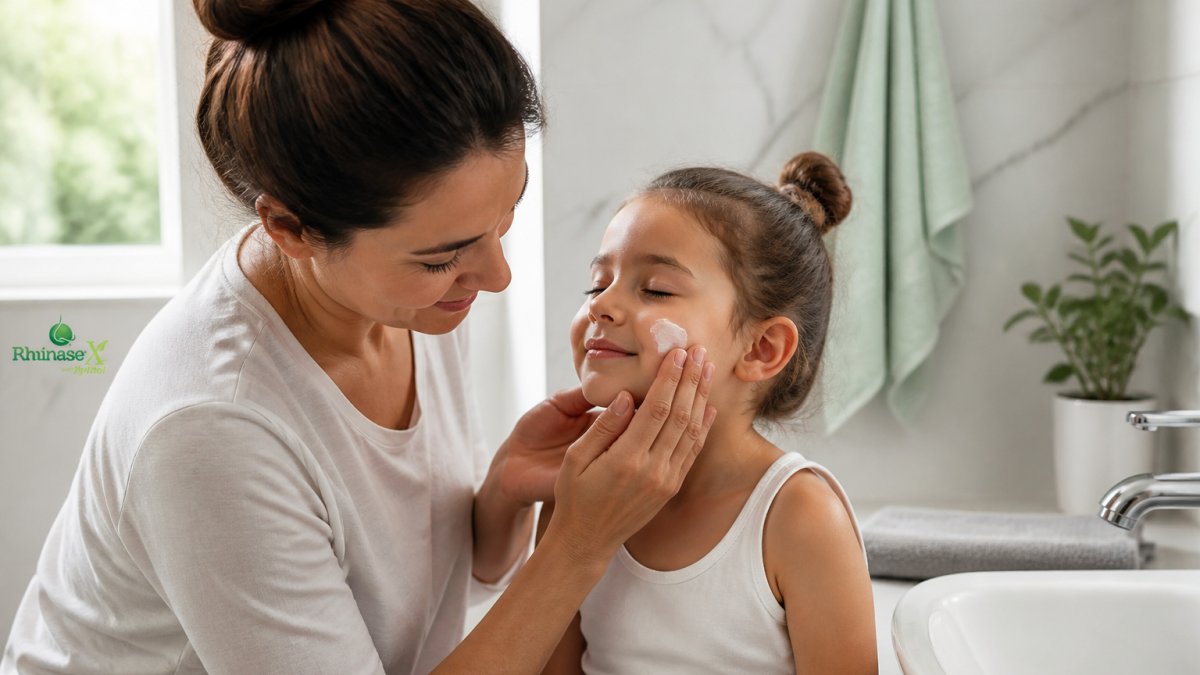
Morning and Night Routine Essentials
Morning routine:
- Rinse with cool or lukewarm water, or use a gentle fragrance-free cleanser if the child's skin feels oily
- Pat dry gently with a soft towel, don't rub
- Apply a fragrance-free moisturizer while skin is still slightly damp
- Apply mineral sunscreen (SPF 30+) as the final step
Night routine:
- Cleanse with a gentle, pH-balanced face wash
- Pat dry gently
- Apply a fragrance-free moisturizer
The entire routine should take less than two minutes. Overcomplicating skincare with too many steps or products increases the risk of irritation. A simple, consistent routine with high-quality fragrance-free products outperforms a complex routine with mediocre products.
For children with very dry or reactive skin, you might simplify further: skip the morning cleanser and use only water, then moisturize and apply sunscreen. At night, cleanse and moisturize. This minimal approach reduces exposure to potential irritants while maintaining essential barrier support.
Consistency matters more than perfection. A child who follows a simple routine every day will see better results than one who uses premium products sporadically. Establish the habit early, and it becomes automatic.
Common Mistakes Parents Make With Children's Sensitive Skin
Parents often make well-intentioned choices that worsen sensitive skin. Understanding these pitfalls helps you avoid them.
Using too many products. More products mean more potential irritants. A cleanser, moisturizer, and sunscreen are sufficient.
Switching products too frequently. Sensitive skin needs time to adapt to new products, at least two to three weeks.
Applying products to wet skin. Moisturizer works best on damp (not dripping wet) skin, which helps lock in hydration.
Using hot water. Hot water strips the skin barrier and causes irritation.
Over-cleansing. Some parents wash their child's face multiple times daily, thinking this prevents problems.
Ignoring patch testing. Introducing a new product without testing it first is the fastest way to trigger a reaction.
Choosing "natural" products without checking ingredients. Natural doesn't mean safe. Many plant-based ingredients and essential oils irritate sensitive skin.
Building non-irritating skincare for kids with sensitive skin doesn't require expensive products or complicated routines, it requires informed choices and consistency. Get started with our dermatologist-recommended Unscented Hand Cream and build a skincare foundation that protects your child's skin for years to come.
Frequently Asked Questions
What ingredients should I look for in non-irritating skincare for kids with sensitive skin?
Prioritize gentle moisturizers with glycerin, ceramides, aloe vera, and plant oils like sunflower or avocado oil. These ingredients strengthen the skin barrier and hydrate without causing irritation. Avoid products with fragrance, parabens, phthalates, and potentially irritating actives like retinol or adapalene. Always check the ingredient list and choose products labeled dermatologist-tested and fragrance-free for maximum safety.
How do I know if a skincare product is irritating my child's skin?
Watch for signs of irritation including redness, dryness, peeling, or visible discomfort within 24-48 hours of use. Start with patch testing on a small area of skin behind the ear or on the inner arm. If any reaction occurs, stop using the product immediately and rinse the area with water. If irritation persists beyond a few hours, consult a pediatrician or dermatologist.
Is fragrance-free skincare better for kids with sensitive skin than unscented products?
Yes, fragrance-free is preferable. Fragrance-free means no fragrance ingredients were added at all, while unscented products may contain fragrance-masking chemicals that can still trigger sensitivity. For children with sensitive skin, fragrance-free formulas reduce the risk of irritation and allergic reactions. Always check the label to confirm fragrance-free rather than assuming unscented is the same.
What should I do if my child has a reaction to a new skincare product?
Stop using the product immediately and rinse the affected area thoroughly with cool water. Apply a gentle, fragrance-free moisturizer if the skin feels dry. Monitor the area for the next 24 hours. If redness, swelling, or irritation worsens or doesn't improve, contact your pediatrician or dermatologist. Avoid introducing new products for at least one week to allow the skin to recover.