

Safe Nasal Moisturizer for Children: A Parent's Guide
Table of Contents
- Choosing a Safe Nasal Moisturizer for Children
- The Best Nasal Spray for Dry Nose Relief in Kids
- Pediatric Nasal Congestion Management Without Medication
- How to Stop Nosebleeds in Children Using Moisturizers
- How to Apply Nasal Moisturizers by Age
- Common Mistakes to Avoid with Kids' Nasal Care
- Frequently Asked Questions
Last Updated: September 13, 2026
Choosing a Safe Nasal Moisturizer for Children
A safe nasal moisturizer for children is a drug-free saline gel or mist that adds moisture to dry nasal passages without steroids or habit-forming decongestants. This guide from Profounda Health & Beauty covers how to pick one, apply it by age, and avoid the mistakes that make dry noses worse.
Children's nasal tissue is thin and reacts quickly to dry air, allergies, and frequent wiping. That is why pediatricians generally steer parents toward simple saline products first. According to the American Academy of Pediatrics guidance on saline nasal drops, saline solutions are a first-line, drug-free option for loosening mucus and easing stuffy noses in kids.
Below, we'll show you exactly how to match a product to your child's age and symptoms, and which ingredients are worth paying attention to.
Understanding Different Delivery Mechanisms
Delivery mechanism decides how a product feels and where it lands. Sprays cover a wide area of the nasal passages in seconds. Gels coat and stay put for hours, which suits overnight dryness and crusting. Drops work best for very young children who cannot tolerate a spray.
- Saline mist or spray: fast, thin, good for daytime congestion and daily maintenance
- Saline gel: thicker, longer-lasting, best for dryness, crusting, and nosebleed prevention
- Drops: slow, controlled, easiest for infants and toddlers
- Bulb syringe plus saline: for clearing mucus in babies who cannot blow their nose
A common mistake is buying a gel for a toddler who fights anything thick. In practice, a mist first, then a gel once they tolerate it, works far better.
Key Ingredients to Look For
Ingredient labels matter more than packaging. Look for isotonic saline (0.9% sodium chloride), which matches the body's natural fluid balance, or hypertonic saline, which draws extra fluid out of swollen tissue. Both are drug-free.
Worth seeking out:
- Xylitol, a natural humectant that helps hold moisture in nasal tissue
- Preservative-free formulas, gentler on sensitive nasal lining
- pH-balanced solutions, which reduce stinging on application
Skip anything listing a topical decongestant for routine use in children. These are not meant for daily maintenance and can cause rebound congestion. A plain moisturizing mist or gel does the job without that risk.
The Best Nasal Spray for Dry Nose Relief in Kids
The best nasal spray for dry nose relief in children is a preservative-free saline mist, used two to three times daily and paired with a gel at bedtime. Mists rehydrate fast; gels hold that moisture through the night.
For families who want one product that covers both jobs, the Rhinase Nasal Care Combo Pack pairs a saline mist with a moisturizing gel. The mist handles daytime dryness and congestion, while the gel stays on nasal tissue longer, which helps with crusting and reduces the irritation that triggers nosebleeds.

What separates a good kids' spray from a mediocre one comes down to three things: no preservatives, a pH-balanced formula, and a gentle mist rather than a hard stream. A hard stream startles children and makes them resist the next dose.
Pediatric Nasal Congestion Management Without Medication
Pediatric nasal congestion management without medication starts with saline. Saline thins mucus buildup so it can drain or be blown out, and it does not carry the rebound risk of medicated sprays. For most children, that is enough.
A practical routine:
- Apply saline mist or drops to loosen mucus
- Wait 60 seconds
- Use a bulb syringe for infants, or have older children blow gently, one nostril at a time
- Repeat up to three times daily during illness
Pair this with a cool-mist humidifier in the bedroom and plenty of fluids. Dry air thickens mucus, so raising indoor humidity often does as much as the spray itself.
Sensory-Friendly Application Tips
Sensory-friendly application is where most parents give up, and it is the angle most guides skip entirely. Children with sensory sensitivities resist the sensation of liquid in the nose, not the product itself. Change the sensation and compliance improves.
- Let your child hold and inspect the bottle first
- Spray toward the side wall of the nostril, not the center septum, which stings
- Count down from three so the spray is never a surprise
- Offer a gel on a clean fingertip instead of a spray if mist is the problem
- Apply right before a preferred activity, so the reward follows immediately
For children who refuse sprays outright, a gel applied with a fingertip gives you the same moisturizing benefit with none of the spray sensation.
How to Stop Nosebleeds in Children Using Moisturizers
How to stop nosebleeds in children comes down to moisture first, pressure second. Most childhood nosebleeds start in the front of the septum, where dry, crusted tissue cracks. Keeping that area moist prevents the crack from forming.
During an active nosebleed, have your child sit upright, lean slightly forward, and pinch the soft part of the nose for a full 10 minutes without checking. Leaning back sends blood down the throat, which causes nausea.
For prevention, apply a saline gel inside the nostrils twice daily, morning and night. The gel keeps the nasal lining supple so it does not crack when your child rubs or picks. A Rhinase Allergy Relief Lubricating Nasal Gel is steroid-free and formulated with dual wetting agents, which is what makes it stay in place rather than run out.

How to Apply Nasal Moisturizers by Age
Application technique changes with age, and using the wrong method is why many parents conclude a product "doesn't work." Below is the age-matched approach.
| Age | Best Format | Frequency | Key Technique |
|---|---|---|---|
| Under 1 year | Saline drops + bulb syringe | 2-3x daily as needed | One drop per nostril, suction gently |
| 1-3 years | Saline mist | 2x daily | Aim at side wall, count down from three |
| 4-8 years | Mist plus gel | Mist 2x, gel at bedtime | Let child hold the bottle first |
| 9-12 years | Mist or gel, self-applied | 2x daily | Teach angle, supervise technique |
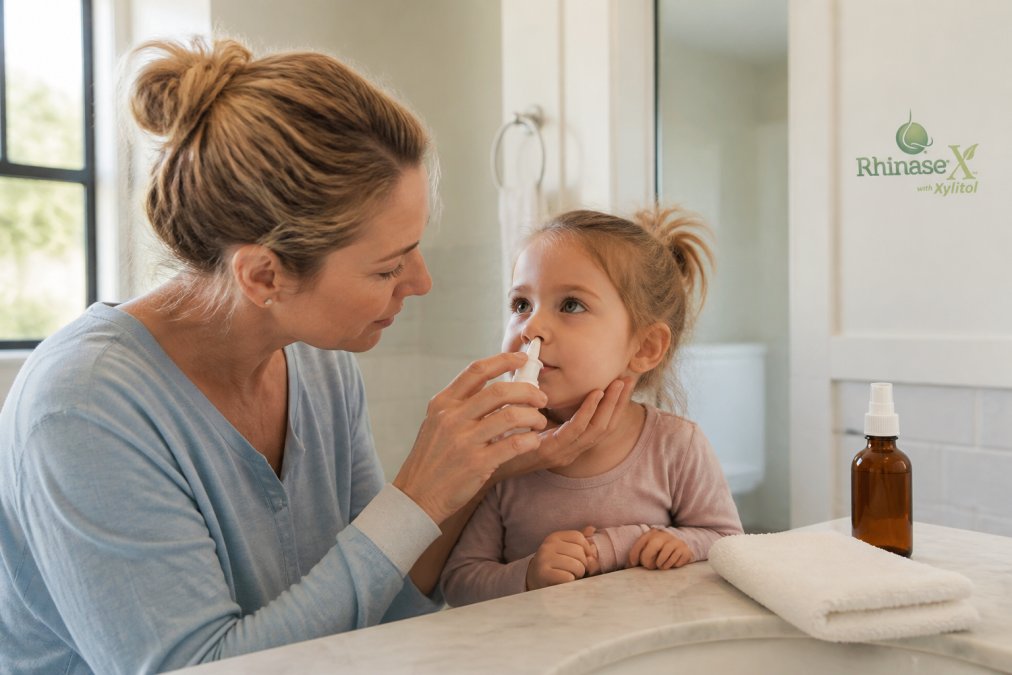
For infants, never insert anything into the nostril beyond the tip of a bulb syringe. For older children, the goal is independence by around age nine, with a parent checking the angle for the first few weeks.
Common Mistakes to Avoid with Kids' Nasal Care
The biggest mistake with kids' nasal care is reaching for a medicated spray when a saline product would do. Topical decongestants are not for routine use in children and can cause rebound congestion that makes the original stuffy nose worse.
Other frequent errors:
- Overusing the spray. More than three or four times daily irritates nasal tissue rather than helping it
- Skipping the humidifier. A spray cannot outwork dry bedroom air night after night
- Using adult-strength products. Children's nasal passages are smaller; adult dosing is not the goal, gentle application is
- Stopping too soon. Daily maintenance matters most for children prone to nosebleeds, not just during flare-ups
What most guides miss is that consistency beats intensity. A child who gets a light mist twice a day for a month does better than one who gets heavy treatment only when symptoms spike.
For daily maintenance, a preservative-free option like Xynase Natural Saline Nasal Spray with Xylitol combines saline with xylitol to help hold moisture, and it is safe across age ranges, which simplifies things for households with more than one child.

Dry, irritated nasal passages in children rarely need medication. They need moisture, consistency, and the right format for your child's age. Profounda Health & Beauty makes that straightforward with doctor-recommended, steroid-free nasal gels and mists built around natural xylitol and balanced saline. The Rhinase line offers dual-action spray and gel solutions, preservative-free options, and formulas designed to prevent nosebleeds rather than just react to them. Get started with Profounda Health & Beauty and give your child drug-free nasal comfort that fits into a daily routine.
Frequently Asked Questions
How to relieve dry nasal passages in kids?
Use a saline nasal moisturizer for children to add moisture and loosen mucus. Apply a small amount of nasal gel inside the nostrils with a clean cotton swab or use a saline mist. Run a cool-mist humidifier in their room, especially during sleep. Encourage extra fluids. Avoid dry, heated air and keep the child away from irritants like smoke. If dryness persists or causes nosebleeds, talk to your pediatrician.
What is a good nasal spray for a dry nose in children?
Look for a drug-free, preservative-free saline spray or gel. Isotonic saline matches the body's natural moisture and is safe for daily use. Xylitol-based sprays like Xynase can help soothe and protect nasal passages. Rhinase nasal gel is doctor-recommended, steroid-free, and safe for children. Always check the label for age recommendations; most saline products are suitable for infants and up, but consult your pediatrician for children under two.
Is saline nasal mist safe for kids?
Yes, saline nasal mist is safe for children when used as directed. It is non-habit forming and contains no steroids or other medications. Saline helps thin mucus, moisturize nasal passages, and relieve congestion. Use a gentle mist for young children, and avoid sharing bottles between family members to prevent the spread of germs. If your child has a chronic condition or is under two, check with a pediatrician first.
What nasal moisturizer is good for a bloody nose?
A nasal gel with moisturizing agents like xylitol and saline is ideal for preventing and treating bloody noses. Apply the gel inside the nostrils two to three times daily, especially before bed and during dry weather. Rhinase nasal gel is steroid-free and safe for children. It creates a protective barrier that keeps nasal tissue from drying out and cracking. For active nosebleeds, pinch the nose and lean forward; seek medical help if bleeding lasts more than 20 minutes.
Are there drug-free alternatives for pediatric nasal congestion?
Yes, drug-free options include saline sprays, nasal gels, and hypertonic saline solutions. These work by thinning mucus and moisturizing tissues, not by constricting blood vessels. Xylitol-based sprays like Xynase offer natural relief and are safe for all ages. For babies, use a nasal bulb syringe with saline drops. Always avoid medicated decongestant sprays in young children unless a doctor prescribes them.
How often can I use a nasal moisturizer on my child?
Most saline and xylitol moisturizers are safe for daily use, up to three or four times a day. Use as needed for dryness, congestion, or before bed. If your child uses a CPAP machine or oxygen therapy, apply before and after therapy sessions. Overuse is rare with drug-free products, but if symptoms persist, talk to your pediatrician. Always follow the product's age-specific dosage instructions.