

9 Best Natural Ingredients for Soothing Throat Sprays
Last Updated: October 26, 2026
Quick Summary
The best natural ingredients for a soothing throat spray are honey and propolis for coating, peppermint, ginger and clove for cooling and warming relief, and sage, echinacea and licorice root for botanical soothing. Sage has the strongest research backing, and a Cochrane review found an echinacea-and-sage spray performed as well as a chlorhexidine-and-lidocaine spray for acute sore throats.
- Honey and propolis form a protective film over irritated throat tissue.
- Peppermint and clove are potent, so a little goes a long way in a spray.
- A Cochrane review found an echinacea-and-sage spray performed as well as a chlorhexidine-and-lidocaine spray.
- Honey-based sprays are not appropriate for infants under one year.
- Make a homemade spray with 2 tablespoons honey, 1 cup distilled water and mint.
Table of Contents
- Why Natural Ingredients Belong in a Throat Spray
- The 9 Best Natural Ingredients for Soothing Throat Sprays
- Herbal Throat Spray Ingredients: What the Evidence Actually Shows
- Honey Throat Spray Benefits: More Than Just Sweetness
- How to Make a Homemade Soothing Throat Spray
- Natural Throat Spray Safety: Dilution, Age Limits, and Red Flags
- Choosing a Ready-Made Spray and Adding It to Your Routine
- Frequently Asked Questions
Why Natural Ingredients Belong in a Throat Spray
Most people reach for a lozenge or a conventional medicated spray when their throat starts to scratch. That works for some, but a growing number of us want something gentler, something we can understand ingredient by ingredient. That is where the best natural ingredients for soothing throat sprays earn their place.
The 9 Best Natural Ingredients for Soothing Throat Sprays
| Group | Ingredients | Main Job |
|---|---|---|
| Coating duo | Honey, propolis | Forms a protective film over irritated tissue |
| Cooling and warming trio | Peppermint, ginger, clove | Delivers sensation-based relief and mild numbing |
| Botanical soothers | Sage, echinacea, licorice root | Targets inflammation and supports immune response |
Honey and Propolis: The Coating Duo
Propolis, the resin bees use to seal their hives, brings antioxidants and antimicrobial compounds to the mix. It pairs naturally with honey in a spray format, which is why you see the two together so often.
Peppermint, Ginger, and Clove: The Cooling and Warming Trio
What most guides miss is dose. Peppermint and clove are potent. A little goes a long way, and too much essential oil can irritate rather than soothe.
Sage, Echinacea, and Licorice Root: The Botanical Soothers
Sage has the strongest research backing of this trio. A study in the Cochrane Database of Systematic Reviews found an echinacea-and-sage preparation performed as well as a chlorhexidine-and-lidocaine spray for acute sore throats. That is a meaningful result for a botanical blend. Readers can also explore Natural Ingredients for Soothing Nasal Passages.
Herbal Throat Spray Ingredients: What the Evidence Actually Shows
| Ingredient | What the evidence supports | What is uncertain or unsupported |
|---|---|---|
| Sage | A Cochrane review found an echinacea-and-sage spray performed comparably to a chlorhexidine-and-lidocaine spray for acute sore throat; sage's tannins and volatile oils are the proposed mechanism | Whether sage alone, without echinacea, delivers the same effect |
| Echinacea | Appears in the same studied combination; traditional immune-support use | Standalone clinical benefit for throat irritation is not well established |
| Honey | Broad support as a coating soother and mild cough suppressant; thick enough to cling to tissue and trigger saliva flow | Optimal dose and frequency in a spray format are not standardized |
| Propolis | Antioxidant and antimicrobial compounds in laboratory studies; traditional use for mouth and throat | Human trial evidence for throat spray use is limited |
| Peppermint | Cooling sensation from menthol that many find calming on raw tissue | Relief is sensation-based, not anti-inflammatory; concentrated oil can irritate |
| Ginger | Long folk history for throat irritation; warming sensation | Rigorous clinical trials for throat spray use are lacking |
| Clove | Eugenol provides mild numbing, which is why it appears in dental remedies | Dose control is difficult; too much essential oil irritates rather than soothes |
| Licorice root | Natural sweetness and soothing quality; traditional use | Long-term use deserves caution; evidence in spray form is thin |
| Chamomile, thyme, lemon balm | Traditional use as gentle botanicals | Rest more on tradition than on rigorous trials |
Honey Throat Spray Benefits: More Than Just Sweetness
One practical note: honey-based sprays are not appropriate for infants under one year, a standard safety rule for honey in any form.
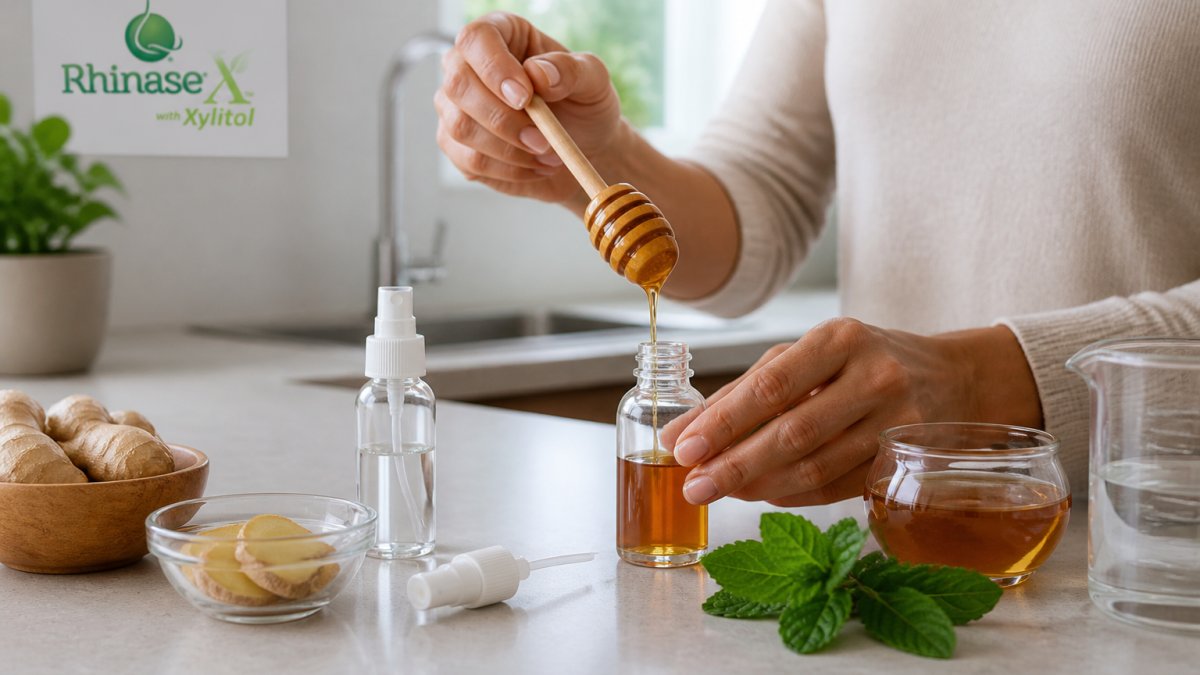
How to Make a Homemade Soothing Throat Spray
What you'll need:
- 2 tablespoons honey
- 1 cup distilled water
- 3-4 fresh mint leaves or a pinch of dried peppermint
- A small glass spray bottle
Steps:
- Warm the distilled water gently. Do not boil.
- Stir in the honey until fully dissolved.
- Add the mint and let the mixture steep for 10 minutes.
- Strain out the solids.
- Pour into your spray bottle and refrigerate.
Natural Throat Spray Safety: Dilution, Age Limits, and Red Flags
Dilution.
Age limits.
Pregnancy and medication interactions.
Allergies.
Red flags.
Choosing a Ready-Made Spray and Adding It to Your Routine
Build it into a routine: spray in the morning, after long talking sessions, and before bed. Consistency beats intensity.
Frequently Asked Questions
What natural ingredients can soothe a sore throat?
A 2009 Cochrane review examined one echinacea-and-sage preparation and one chlorhexidine-and-lidocaine spray for acute sore throats. Choose a spray whose label lists each ingredient clearly.
Are natural throat sprays safe to use every day?
Check the product label for its suggested use. If you have questions about using a product, ask a health professional.
Does honey actually help soothe a sore throat?
Honey throat spray benefits come mainly from its coating action. It forms a film over irritated tissue, which calms scratchiness and helps suppress a dry cough. Honey also has mild antimicrobial properties. It works best as a soothing layer rather than a cure, so pair it with warm liquids and rest. Avoid honey sprays for infants under 12 months, and choose products that list honey as a primary ingredient rather than a flavoring near the end of the list.
When should you seek medical care for a sore throat?
For questions about sore-throat symptoms, consult a health professional.
A scratchy throat is a small problem until it ruins your day. The right formula, whether homemade or ready-made, makes the difference. At Profounda Health & Beauty, we build drug-free, doctor-recommended care with natural xylitol and advanced saline, and our throat spray brings propolis, honey, and mint together in one pocket-sized bottle. Get started with Profounda Health & Beauty and give your throat the soothing relief it deserves.
