

Drug-Free Relief for Nasal Congestion: 7 Methods That Work
Table of Contents
- Understanding Nasal Congestion and Why Drug-Free Relief Matters
- Steroid-Free Nasal Spray Alternatives That Deliver Results
- How to Use Saline Nasal Spray Correctly for Maximum Relief
- Benefits of Xylitol in Nasal Care and Congestion Management
- Natural Ways to Thin Mucus and Improve Drainage
- The Role of Humidity and Hydration in Sinus Relief
- When to See a Doctor and Red Flags to Watch For
- Conclusion
Last Updated: August 21, 2026
Understanding Nasal Congestion and Why Drug-Free Relief Matters
Nasal congestion affects millions of people daily, from seasonal allergies to environmental irritants and chronic sinus issues. When your nasal passages become inflamed or filled with excess mucus, breathing becomes difficult, sleep suffers, and quality of life declines. Many people reach for over-the-counter decongestants or steroid sprays without realizing that effective drug-free relief options exist and often work better without side effects or dependency risks.
At Profounda Health & Beauty, we understand that not everyone wants to rely on medications for everyday nasal care. Whether you're dealing with post-nasal drip, allergy-related congestion, or irritation from medical equipment like CPAP machines, drug-free solutions exist. The key is understanding how your nasal passages work and what actually clears congestion at the source.
Your nasal cavity produces mucus constantly, that's normal and healthy. The problem isn't mucus itself; it's when inflammation thickens it or swelling narrows your passages. Traditional decongestants shrink blood vessels temporarily, leading to rebound congestion when you stop. Drug-free approaches work differently: they thin mucus, reduce inflammation naturally, and restore moisture without chemical dependency.
This guide covers seven proven methods for drug-free nasal relief that address root causes, not just symptoms.
Steroid-Free Nasal Spray Alternatives That Deliver Results
The most effective drug-free relief starts with understanding what makes a nasal spray work. Steroid-free alternatives focus on saline irrigation and natural humectants that draw moisture into tissues.
Saline nasal sprays are the foundation of drug-free care. Unlike decongestants, saline physically flushes irritants, allergens, and thickened mucus from your nasal passages. The salt concentration matters significantly. Isotonic saline (0.9% salt) matches your body's natural fluid balance and is gentle enough for daily use (the FDA). Hypertonic saline draws additional fluid from swollen tissues, providing stronger decongestant effects without chemicals.
Advanced steroid-free alternatives add natural ingredients like xylitol. Products like Rhinase X Natural Nasal Mist Spray with Xylitol combine hypotonic saline with xylitol to deliver dual-action relief. The hypotonic formulation reduces inflammation while xylitol promotes healing and prevents secondary infections.

A fine mist allows the solution to coat your entire nasal cavity evenly, whereas a stream spray concentrates liquid in one area. Most users find mist delivery more comfortable and effective for daily use.
If you were using steroids for seasonal allergies, a combination of saline rinses and natural moisturizers often provides equivalent relief. If your congestion stems from inflammation triggered by environmental factors, dry air, pollution, or CPAP equipment, drug-free options frequently outperform steroids because they address moisture loss directly.
How to Use Saline Nasal Spray Correctly for Maximum Relief
Most people don't realize their nasal spray technique directly impacts effectiveness. Incorrect application wastes product and delivers poor results.
Proper technique requires three steps:
-
Clear your passages first. Gently blow your nose to remove loose mucus. If one side is severely blocked, focus on opening that passage first by tilting your head slightly toward the clear side.
-
Position the spray bottle correctly. Hold the bottle upright and insert the nozzle into your nostril at a 45-degree angle toward the back of your nasal cavity. Tilt your head slightly forward, not backward.
-
Activate and breathe naturally. Press the spray button while breathing gently through your nose. You should feel the mist coat your nasal passages. Don't sniff sharply; let gravity and normal breathing do the work. Repeat on the other side.
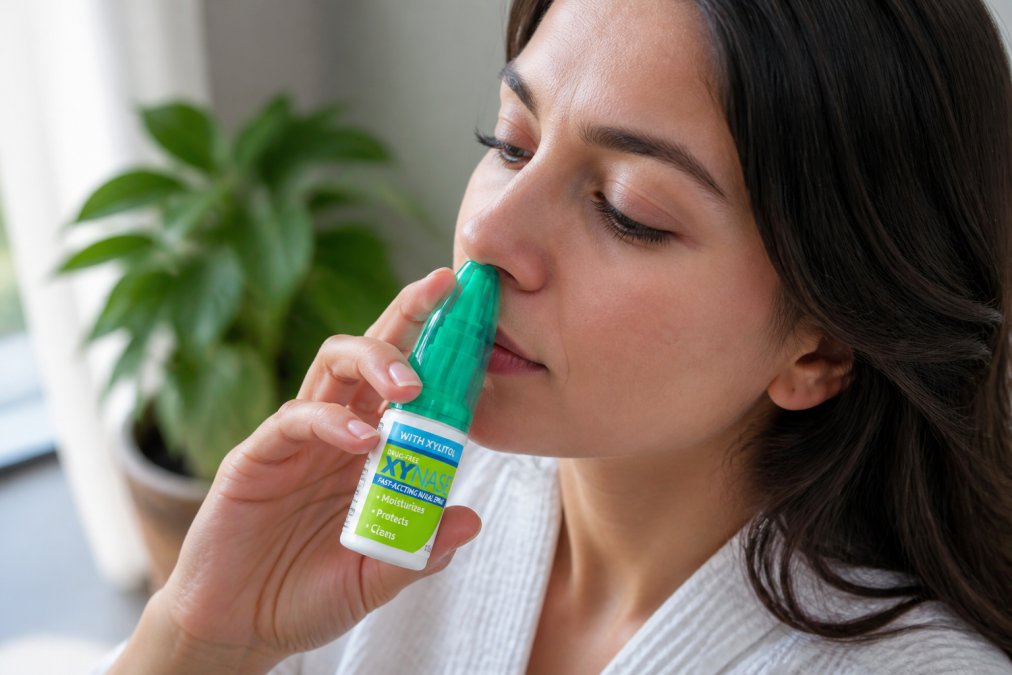
After spraying, keep your head tilted slightly forward for 10-15 seconds to allow the saline to coat your entire nasal cavity and drain naturally.
For daily maintenance with products like Xynase Natural Saline Nasal Spray with Xylitol, use 1-2 sprays per nostril twice daily. During acute congestion, you can increase to every 4 hours, but consistency beats frequency. Regular use prevents congestion from building up in the first place.

Common mistakes include tilting your head too far back, pressing too hard, and expecting instant results. Saline works gradually by restoring moisture and flushing irritants. Most people notice improvement within 3-5 minutes, but full relief often takes 15-20 minutes as mucus thins and drains naturally.
Benefits of Xylitol in Nasal Care and Congestion Management
Xylitol has become increasingly popular in nasal care because it addresses congestion through multiple pathways. Unlike steroid-based approaches that suppress inflammation chemically, xylitol works with your body's natural systems.
Xylitol is a five-carbon sugar alcohol found naturally in birch bark and other plants (peer-reviewed research). In nasal care, it functions as a humectant, attracting and holding moisture in your nasal tissues. This is particularly valuable for people whose congestion stems from dryness rather than pure inflammation. When your nasal lining dries out, mucus thickens and congestion worsens. Xylitol reverses this cycle by maintaining tissue hydration.
The antimicrobial properties of xylitol are equally important. Bacteria cannot metabolize xylitol the way they do other sugars, so it inhibits bacterial growth while promoting beneficial microbiota. This reduces your risk of secondary sinus infections, a common complication when congestion persists.
Research shows that xylitol supports your nasal cavity's mucociliary clearance system. Your nose naturally moves mucus toward your throat through coordinated ciliary action. When congestion develops, this system fails. Xylitol helps restore proper mucus drainage by maintaining the right fluid balance and reducing inflammation that impairs ciliary function.
The Rhinase X Combo Pack pairs xylitol spray with a complementary gel formula, providing options for different situations. The spray works best for acute congestion and daily maintenance, while the gel offers sustained relief for nighttime use or severe dryness.

For parents concerned about safety, xylitol-based nasal products are completely drug-free and suitable for children. Unlike decongestants that carry age restrictions, xylitol formulations work safely across all ages.
Natural Ways to Thin Mucus and Improve Drainage
Thick, sticky mucus is often the real culprit behind congestion, not inflammation alone. Several natural approaches effectively thin mucus without medications.
Hydration is foundational. When you're dehydrated, your body produces thicker mucus. Drinking adequate water, roughly half your body weight in ounces daily, keeps mucus thin and mobile. This simple step alone resolves congestion for many people.
Steam inhalation works by adding moisture directly to your nasal passages. Boil water, pour it into a bowl, lean over with a towel draped over your head, and breathe deeply for 10-15 minutes. The warm, moist air loosens thick mucus immediately. You can enhance this by adding a few drops of eucalyptus oil. Repeat 2-3 times daily during acute congestion.
Saline nasal irrigation using a neti pot provides deeper mucus clearance than sprays. Fill the pot with warm isotonic saline solution. Tilt your head over a sink, insert the spout into one nostril, and let gravity draw the solution through your nasal cavity and out the other nostril. This flushes out accumulated mucus and allergens thoroughly.
Honey has mild antimicrobial and anti-inflammatory properties. A spoonful of raw honey can soothe your throat and reduce post-nasal drip. For children over one year old, honey is a safe, effective cough suppressant.
Ginger and turmeric contain natural anti-inflammatory compounds. Brewing ginger tea or adding turmeric to meals supports your body's natural inflammation response.
The key principle: thick mucus requires moisture and movement. Hydration provides moisture, steam loosens congestion, and saline irrigation physically removes accumulated mucus.
The Role of Humidity and Hydration in Sinus Relief
Environmental humidity directly impacts your nasal health. When humidity drops during winter heating season or in naturally dry climates, your nasal passages lose moisture faster than your body can replace it. This triggers inflammation and thickens mucus, creating congestion even without allergies or infection.
Your nasal lining is designed to stay moist. Specialized cells produce a thin mucus layer that traps irritants while staying thin enough to drain naturally. When humidity falls below 40%, your nasal tissues begin drying out (the NIH). Below 30%, congestion becomes nearly inevitable for most people.
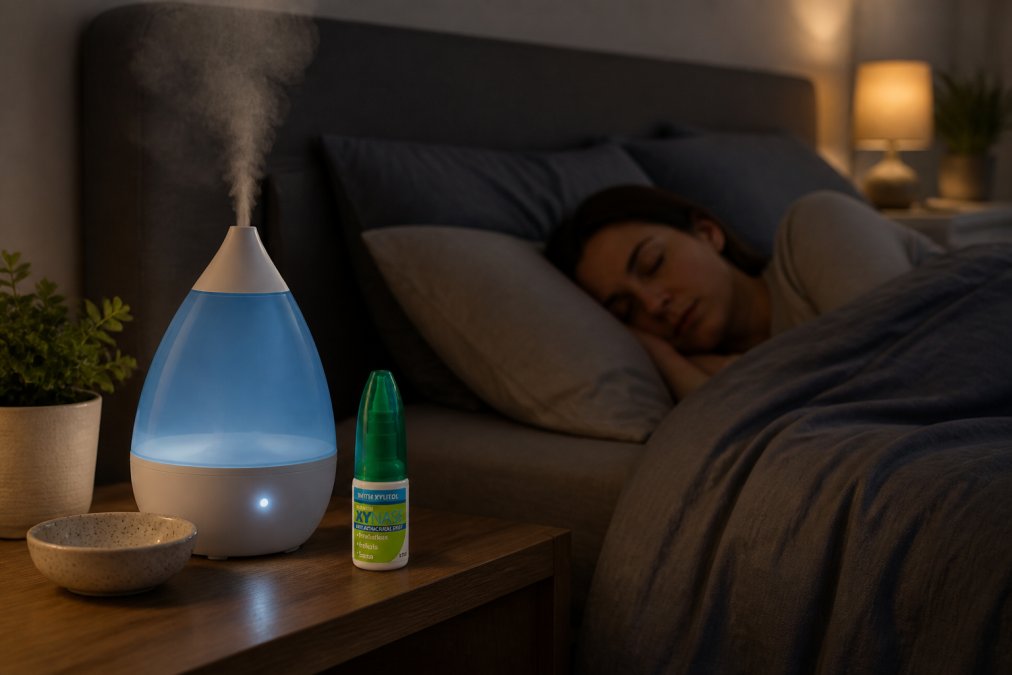
Humidifier use is one of the most underrated congestion solutions. Adding moisture to your bedroom air, particularly where you sleep, dramatically improves nighttime congestion. Aim for 40-60% relative humidity, which you can measure inexpensively with a hygrometer. Cool-mist humidifiers are generally preferred because they don't create scalding steam.
Hydration works systemically. When you drink adequate water, your body produces thinner mucus throughout your respiratory system. Dehydration thickens mucus everywhere, not just your nose.
The combination of external humidity and internal hydration is particularly powerful. Someone using a humidifier while staying well-hydrated will clear congestion far faster than someone doing only one. This is especially important for CPAP users, whose equipment can dry nasal passages significantly. Using a humidified CPAP chamber combined with a bedroom humidifier and consistent hydration often eliminates CPAP-related nasal irritation entirely.
Seasonal adjustments matter. During winter, increase humidifier use and water intake. During summer, outdoor humidity naturally helps, but air conditioning can dry you out again.
For people with post-nasal drip, adequate hydration actually helps by thinning the drainage. Thinner post-nasal drip causes less throat irritation and coughing.
When to See a Doctor and Red Flags to Watch For
Most nasal congestion resolves with self-care within 1-2 weeks. However, certain situations warrant professional evaluation.
Seek medical attention if congestion persists beyond 10 days without improvement. This suggests either a bacterial infection or an underlying condition like deviated septum or nasal polyps.
Severe facial pain or pressure, particularly around your sinuses, indicates possible sinusitis. While drug-free relief helps mild sinus pressure, moderate to severe pain requires professional evaluation.
Fever accompanying congestion suggests infection. A doctor can distinguish between viral colds and bacterial sinus infections, which require antibiotics.
Bloody nasal discharge or frequent nosebleeds warrant evaluation. While occasional nosebleeds are common, frequent bleeding suggests severe dryness, nasal trauma, or underlying bleeding disorders.
Congestion affecting only one side of your nose persistently can indicate polyps, deviated septum, or other structural issues requiring professional assessment.
Congestion accompanied by vision changes, severe headaches, or swelling around your eyes suggests possible complications needing immediate medical attention.
For children, congestion lasting more than two weeks or interfering with sleep and feeding deserves evaluation to rule out allergies or structural issues.
Many conditions causing congestion respond well to drug-free approaches once properly diagnosed. Professional guidance ensures you're not missing something important while pursuing natural relief.
Making the Switch: From Medicated to Drug-Free Relief
Transitioning from steroid or decongestant sprays to drug-free relief requires understanding what to expect. Many people worry that stopping medicated sprays will cause immediate congestion, but the reality is more nuanced.
If you've been using steroid sprays, your nasal tissues have adapted to that treatment. Stopping suddenly might cause temporary rebound congestion lasting 3-7 days as your tissues return to normal. Starting drug-free alternatives during this transition period helps significantly. The Rhinase X Combo Pack provides comprehensive coverage during this adjustment phase.
If you've been using decongestant sprays, rebound congestion is more pronounced. Gradual transition works better than quitting cold turkey. Reduce usage frequency over 1-2 weeks while simultaneously introducing saline alternatives. This allows your nasal tissues to gradually normalize without overwhelming rebound effects.
Drug-free relief works differently than decongestants, it doesn't create the artificial "wide open" sensation. Instead, it restores normal, healthy nasal function. This takes adjustment, but most people prefer it once they adapt.
Document your experience during transition by tracking congestion levels, sleep quality, and any side effects daily. Most people report that within 2-3 weeks of consistent drug-free care, their baseline congestion improves compared to their medicated baseline. This happens because drug-free approaches address underlying causes rather than masking symptoms.
Drug-free relief for nasal congestion isn't a compromise, it's often superior to medicated alternatives for long-term nasal health. Saline irrigation, xylitol-based formulations, humidity management, and hydration work together to restore your nasal passages' natural function. Profounda Health & Beauty's Rhinase X Natural Nasal Mist Spray and Xynase Natural Saline Nasal Spray provide doctor-recommended, steroid-free formulations that address congestion at its source. Start with consistent saline use, maintain adequate humidity and hydration, and give your nasal passages 2-3 weeks to respond. Most people find that drug-free approaches deliver lasting relief without dependency or rebound effects.
Frequently Asked Questions
Q: Are saline sprays considered drug-free nasal relief?
A: Yes, saline nasal sprays are completely drug-free. They contain only salt and water, making them safe for all ages, including children and pregnant women. Saline works by moisturizing nasal passages and helping to thin mucus so it drains more easily. Unlike medicated decongestants, saline sprays don't carry risks of dependency or rebound congestion, making them ideal for long-term use and chronic nasal congestion management.
Q: What are the benefits of xylitol in nasal care?
A: Xylitol is a natural humectant that draws moisture into nasal tissues and helps prevent bacterial growth. Xylitol can reduce mucus production, decrease inflammation, and improve mucociliary clearance, the natural process your nasal passages use to drain mucus. It also helps restore the protective barrier of your nasal cavity, making it especially beneficial for those with chronic dryness, allergies, or irritation from medical equipment like CPAP machines.
Q: How do I decongest my nose without medication?
A: Multiple drug-free methods work together: use saline nasal irrigation or spray to thin mucus and reduce inflammation, increase humidity in your environment with a humidifier, drink plenty of water to hydrate your body, apply warm steam inhalation, and elevate your head while sleeping. Natural saline solutions with xylitol offer added benefits by moisturizing nasal passages and supporting your body's natural drainage process. Combining these approaches typically provides faster relief than any single method alone.
Q: Is drug-free nasal relief safe for children and long-term use?
A: Drug-free saline and xylitol-based nasal solutions are safe for children of all ages and can be used long-term without side effects or dependency concerns. Unlike steroid nasal sprays or medicated decongestants, these options don't suppress natural nasal function or carry risks of rebound congestion. They're especially valuable for children with allergies, parents managing post-nasal drip, and anyone seeking sustainable relief without chemical dependency or systemic effects.
This article was written using GrandRanker